Thursday, January 6, 2011

Veggies and Greens in the Dead of Winter


Green Growers Maxim #4 -- There are two rules for watering: 1. For inside plants, when in doubt, don't. 2. For outside plants, when in doubt, do.

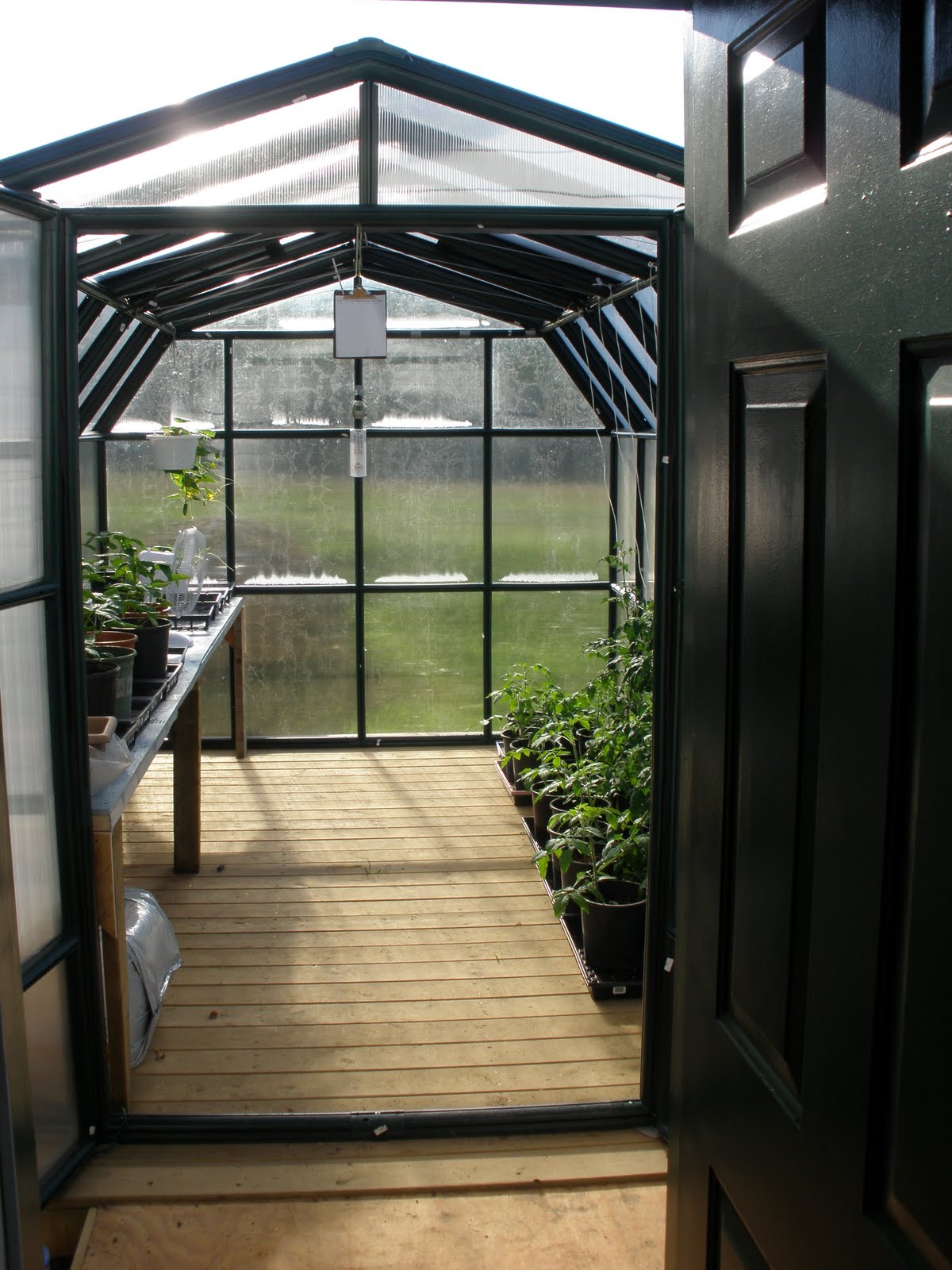
This winter I'm taking some risks and testing the limits of my GH365 greenhouse. I shut off the breaker for the electric back-up in my water heater back in mid-November. So I'm essentially heating my greenhouse by passive solar and solar thermal means only. We've had some cold periods reaching a low of minus 31.29 degrees celsius on December 14th. But what is of greater concern is the fact that we've had an unusually high number of overcast (cloudy and part sun) days since November. And yet the coldest temperature I've recorded in the greenhouse was +4.49 degrees celsius, not surprisingly, on December 14th. Otherwise, it never went below +5 C.
Now that's still pretty cold for a greenhouse but as you can see from my photographs taken earlier today (January 6, 2011) the vegetables, for the most part, are performing well. Admittedly, the cold sensitive plants like tomatoes are taking an unusually long time to germinate and to ripen. But the ripening has more to do with the lack of sunshine than the lack of warm temperatures. Even one day with good clear sun has noticeably shown a significant reddening of those reaching maturity.
I've included some photos showing the ripening tomatoes as well as the one with the smallish red one and two green ones with broccoli in the background. These are on a tomato plant that I seeded on November 11, 2009 --over a year old and still producing. Pretty amazing!
Notice as well that the other more cold-resistant veggies like the broccoli and spinach behind the parsley are doing great. Not a bad way to spend the winter!


Friday, October 29, 2010

Wheatgrass Juice


Green Growers Maxim #3 -- "A gardener is a producer. Anyone else is just a consumer".
Wheatgrass juice has been used for thousands of years around the world for its health benefits and healing properties. As an energizer, it gives one a great feeling of vitality. It is a 'whole food' containing all the nutrients for human existence. Wheatgrass juice contains every essential amino acid; vitamins A, B, C, E and K; a full complement of minerals including calcium, potassium, iron, magnesium and phosphorus as well as an abundance of enzymes which assist in nutrient digestion, heart muscle toning and slowing cellular aging. As a healer, it is an excellent detoxifier; the chlorophyll in it is a blood purifier. It can repair ulcers, reduce high blood pressure, fight bacterial growth, purify the liver, improve digestion and much more.
GH365 Wheatgrass Juice (Good Health Every Day) is all organic. The seeds are 'hard red spring wheat' certified organic by OPAM. It is grown using all organic fertilizers -- well-aged local manure, natural fish fertilizer, peat moss and horticultural grade perlite and vermiculite.
And it is all grown, harvested, juiced and frozen in our unique solar thermal greenhouse.
Look for our 'Wheatgrass Juice' page with more details coming soon on our website.

Thursday, August 19, 2010

Nolalu Country Market


Green Growers Maxim #2 -- If you want to be happy for an hour, drink wine. If you want to be happy for a day, run away. If you want to be happy for a year, get married. If you want to be happy forever, be a gardener. (Ancient Greek saying).
Country (Farmers) Markets have been around over 200 years in Ontario with the first one established in Kingston in 1780. With a surge in the popularity of supermarkets and their 'convenience foods', pre-packaged and highly processed, country markets declined in the sixties and seventies. But there was a resurgence in the 1980's. Now with greater awareness of food quality and the impact on our health, country markets are more popular than ever. There are some 157 farmers markets listed on the farmersmarketsontario.com website.

And that does not include the 'Nolalu Country Market'. Held every friday from 4 pm to 7 pm at St. Urho's at the junction of Hwy 588 and 590, our little market is growing with increasing numbers of vendors and customers ranging from locals to campers. They come secure in the knowledge that the food is fresh, safe to eat and the next best thing to harvesting it yourself. Also all the artisans' crafts and creations are hand-made locally. Not only is it a way of connecting to the land, it is also a way of connecting with one another-- a wonderful social occasion. We may not always have exactly what you're looking for, but we'll always have a friendly 'Hi Neighbour!'.

Friday, July 16, 2010

Auxiliary Greenhouse


Green Growers Maxim #1 -"Anybody who thinks that gardening begins in the spring has wasted the fall and winter".


One of the important advantages that I came to realize in the early spring was the possibility and opportunity to now get bedding plants (starters) seeded and growing early. I had advanced starters growing as early as February in the main solar greenhouse. I realized that, with a good quality conventional second greenhouse, I could get those starters moved into an interim location, to clear space in the main greenhouse, and thereby be able to transplant them into an outside garden as early as the last frost would allow. Consequently, now it's possible to transplant, for example, tomatoes that are already blooming or even bearing fruit. Thereby, you can begin to pick from your outside garden, vine-ripened tomatoes and other ripe vegetables as early as May even in this cold climate region. This is much better than having to wait until the end of August or even September to begin to pick tomatoes while often worrying about the first frost destroying them. This happened to many of us in late summer 2009.


Additionally, the second greenhouse allows me to clear space in the solar greenhouse all summer long which allows me to almost double production. And finally, it also allows me to be able to use the conventional greenhouse as a control facility to measure the advantages of the solar greenhouse. To that end, I'm now also taking daily readings and noting the current temperature, maximum and minimum over the previous 24 hour period and the relative humidity in the second greenhouse to compare with the solar greenhouse prototype.

Saturday, June 5, 2010

The Life and Times of Tommy Tomato


I began to make entries regarding our so called "Tommy Tomato" starting on March 13th, March 19th, March 22nd and April 7th including photos. You might want to check back. "Tommy" is a standard red beefsteak type tomato called "Cobra" from Stokes Seeds. It is described (in part) as -- "Best tasting of the greenhouse grown hybrids. Cobra has field ripened taste. Large and firm".


The seed was planted on Nov. 11, 2009. It germinated eleven days later on Nov. 22, '09. We transplanted "Tommy" from a 4" pot to an 8" pot on January 18, 2010. Blooms began to show on or around March 5th and we did our first hand-pollinating on March 11th. By March 16th, the fruit began to appear and was perhaps 1/4" in diameter at that point growing to about 3/4" in diameter by a week later on March 22nd. This morning, June 5th, 2010, I picked "Tommy" off the vine. He now measures about 2 1/2" in diameter and is deep red in colour. Slightly smaller than some but a very healthy looking tomato. Later today, I look forward to enjoying the taste and nourishment that the now late "Tommy" will provide.


Tommy's place in the greenhouse was toward the back and I think his growth was a bit stunted due to overcrowding and therefore some lack of light that would optimize growth.


Saturday, May 29, 2010

Gull Bay and Prospective GH365 Greenhouse site


On Wednesday, May 26th, my friend Sheryl and I drove to Gull Bay First Nation, some 2 hours north of Thunder Bay. Sheryl being an avid photographer, we stopped several times to take photos, and to simply enjoy the view.


Gull Bay 1st Nation is located on the west shore of Lake Nipigon. As we drove up toward the community, it was a study in contrasts. Several homes were modest to the point of wondering how the families survived the long cold winters in them. Upon reaching the heart of the community of about 350 to 400 people, we saw the new modern health centre nearing completion. Also the new "Band Office", now more specifically referred to as the "Government Agency Building", which was well appointed with inspiring woodland native art prominent on the walls of the boardroom and elsewhere. Again the contrast of young teen-age girls clutching babies, the more than usual dogs and abandoned vehicles in a spectacular setting overlooking Lake Nipigon.


We met with Jordan Hatton (Resource Development Advisor) and Tausha Esquega (Economic Development Officer) who had visited my GH365 Greenhouse several weeks prior to that and quite liked what they saw. They had maintained their interest in having one built at their Gull Bay community.


Tausha took us around for a tour of the local sites including the new recreation centre and hockey rink under construction as well as the tiny store that contained little more than potato chips, chocolate bars, soft drinks, freezies and cigarettes. We now understood the serious need for locally grown nutritious food.

Monday, May 3, 2010

Terrace Bay Presentation and Nolalu Sale


On Saturday April 24th, I took a three hour drive to Terrace Bay to participate in the 2010 Green Trade Show. My half hour PowerPoint presentation was well received and I had many productive conversations at my display table. Following that on Saturday May 1st, I participated in the Nolalu Spring and Summer Marketplace which I also help to organize. I had for sale a wide assortment of starters. The most popular ones sold included tomatoes and green peppers. Attached are photos taken of me at both events. Also this weekend we tasted our first ripe tomatoes from the greenhouse. In a few days there should be a pound or two available of several varieties including Sub-Arctic Plenty, Cobra Beefsteak and Camelia (a cherry tomatoe).